Cost of 20kVA Solar System with Lithium Battery in Accra
Discover the engineering requirements and current market pricing for a 20kVA solar system in Accra, including LiFePO4 battery sizing and ROI metrics.
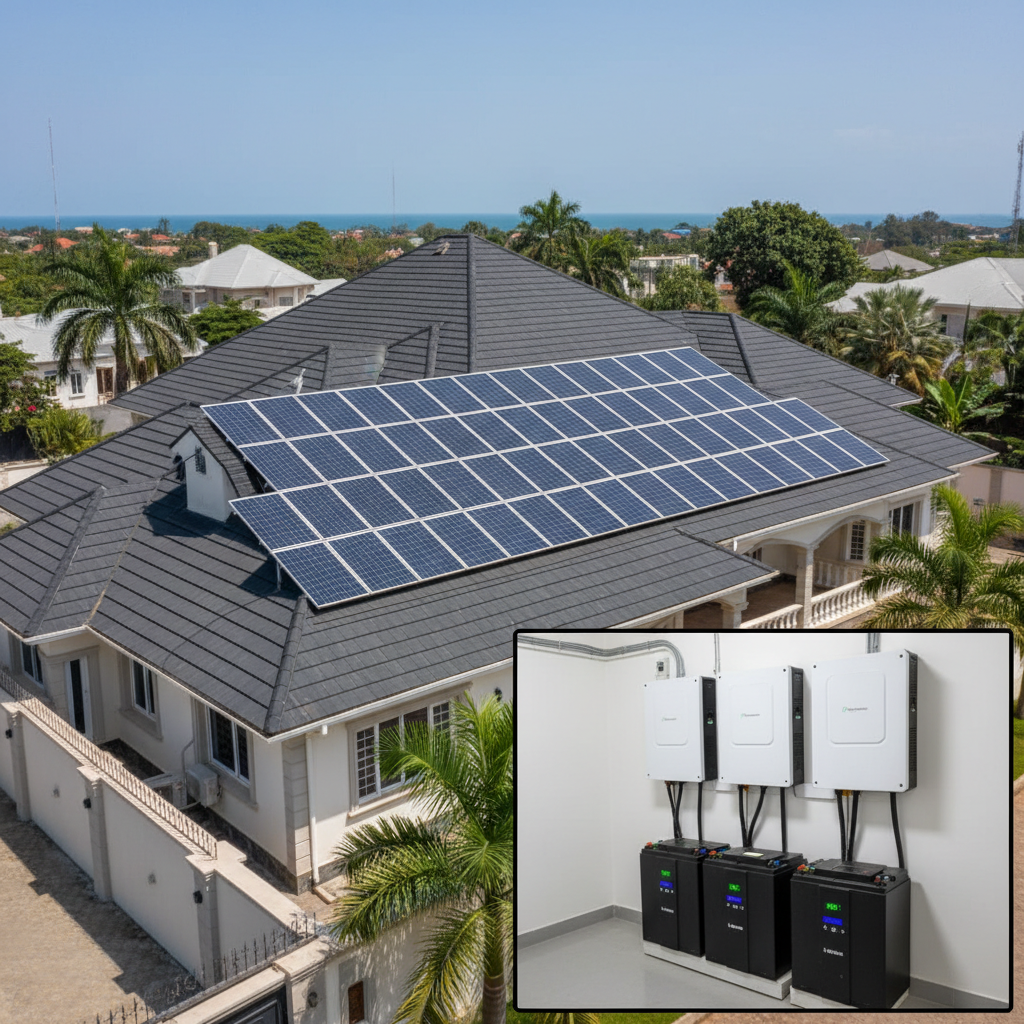
Why This Question Matters in Accra Now
For residents and business owners in Accra, the energy landscape has become increasingly volatile. As the Electricity Company of Ghana (ECG) navigates complex debt restructuring and power procurement challenges, the frequency of 'dumsor' (load shedding) has escalated. Simultaneously, the rising cost of petrol and diesel used to power backup generators has made traditional alternatives economically unsustainable.
Investing in a solar solution is no longer a luxury but a strategic financial hedge. According to ESMAP, Ghana possesses significant solar radiation potential, yet many installations fail because they are undersized or utilize outdated Lead-Acid technology. A 20kVA system, when engineered correctly with Lithium Iron Phosphate (LiFePO4) storage, can effectively transition a large home or a medium-sized office off the grid entirely.
By the numbers: The Public Utilities Regulatory Commission (PURC) has implemented multiple tariff adjustments in recent years, with some residential and commercial increments exceeding 18-25% annually to reflect the depreciating Cedi and fuel costs. Source: BloombergNEF
Real-World Load Profile Analysis
Before discussing the cost of 20kVA solar system with lithium battery in Accra, we must define what a 20kVA system actually powers. A common mistake in the West African market is equating kVA directly to kW without accounting for the Power Factor (PF). Most high-quality inverters have a PF of 0.8 to 1.0. For our engineering calculations, we assume a PF of 0.9, giving us 18kW of usable continuous power.
| Appliance Type | Quantity | Estimated Wattage | Daily Runtime (Hours) | Daily Consumption (kWh) |
|---|---|---|---|---|
| Inverter Air Conditioner (1.5HP) | 5 | 1,200W (Avg) | 8 | 48.0 |
| Deep Freezer/Refrigerator | 3 | 200W | 24 | 14.4 |
| LED Lighting (Whole House) | 30 | 10W | 6 | 1.8 |
| Pumping Machine (1HP) | 1 | 750W | 1 | 0.75 |
| Entertainment (TVs/Sound) | 4 | 300W | 5 | 6.0 |
| Office Equipment (PCs/Servers) | 6 | 400W | 9 | 21.6 |
| Total Estimated Daily Load | ~92.55 kWh |
This load profile suggests that while the peak demand stays well within the 18kW limit, the total energy consumption requires a robust battery bank and a large PV array to ensure autonomy during the night and cloudy days.
Inverter Sizing Math
In Accra, the ambient temperature often exceeds 30°C, which can lead to thermal derating of power electronics. A 20kVA system typically utilizes either a large single-phase industrial inverter or a three-phase configuration (e.g., 3 x 8kVA or 3 x 10kVA units synchronized).
When calculating capacity, we use the formula: Required Inverter Capacity = (Sum of Constant Loads + Surge Loads of Largest Motor) / Power Factor.
A 20kVA unit provides a surge capacity often 2x its rating for 10-20 milliseconds, which is vital for starting air conditioner compressors and borehole pumps. However, running an inverter at 90% capacity continuously in the Ghanaian heat reduces its lifespan. We recommend a maximum continuous loading of 70-75%.
Engineer's note — Maypatronic Solar Engineering Team: Always verify if your 20kVA inverter is a low-frequency (transformer-based) or high-frequency unit. Low-frequency inverters, while heavier and more expensive, handle the 'dirty' power spikes common in Accra’s industrial zones much better than high-frequency alternatives. View our high-durability options at our /shop.
LiFePO4 Battery Sizing Math
Traditional tubular or AGM batteries are ill-suited for the Accra climate due to their sensitivity to heat and limited cycle life (approx. 500-800 cycles at 50% Depth of Discharge). Lithium Iron Phosphate (LiFePO4) is the gold standard, offering 4,000 to 6,000 cycles at 80% Depth of Discharge (DoD).
To calculate the required battery bank for a 20kVA system:
- Daily Night Consumption: If 60% of the 92.5 kWh load happens at night, we need 55.5 kWh of usable storage.
- Depth of Discharge Factor: To pull 55.5 kWh safely at 80% DoD, we need 55.5 / 0.8 = 69.3 kWh total capacity.
- Voltage Alignment: A 20kVA system typically operates on a 48V or high-voltage (HV) DC bus. A standard 48V 100Ah LiFePO4 module provides 4.8kWh. Therefore, 69.3 / 4.8 ≈ 15 modules.
By the numbers: According to the International Renewable Energy Agency (IRENA), LiFePO4 battery prices have fallen by over 80% in the last decade, yet they still represent approximately 40-50% of the total system cost in high-capacity installations like a 20kVA setup.
Solar PV Array Sizing and Roof Footprint
In Accra, we benefit from approximately 4.5 to 5 Peak Sun Hours (PSH) on average, though this dips during the harmattan and rainy seasons. To recharge a 69kWh battery bank while simultaneously powering an 18kW daytime load, the PV array must be oversized.
Required PV Generation = (Daytime Load) + (Night Load / Round Trip Efficiency of Battery) Assuming 95% Round Trip Efficiency (RTE) for Lithium, the math for a 20kVA system usually dictates a PV array between 15kWp and 25kWp depending on the autonomy required.
For a 20kWp array using 550W Tier-1 Monocrystalline modules:
- Number of Panels: 20,000W / 550W ≈ 37 panels.
- Roof Space: Each panel is roughly 2.6 square meters. 37 x 2.6 = 96.2 sqm.
- Weight: Each panel is ~28kg. Total weight on roof = 1,036kg (excluding mounting rails).
It is critical to ensure your roof structure can support this load. You can use our /estimator to get a precise calculation for your specific roof orientation.
Indicative Cost Breakdown in NGN/GHS
While this article focuses on the cost of 20kVA solar system with lithium battery in Accra, we often price in USD or NGN/GHS equivalents due to equipment import costs. Below is a breakdown for a high-end /bundles#platinum tier installation.
| Component | Specifications | Estimated Cost (NGN Equivalent) | Estimated Cost (GHS) |
|---|---|---|---|
| Inverter | 20kVA Pure Sine Wave (Parallel Ready) | ₦4,500,000 - ₦6,000,000 | GH¢ 45,000 - 60,000 |
| Lithium Battery | 60kWh - 80kWh LiFePO4 Bank | ₦18,000,000 - ₦24,000,000 | GH¢ 180,000 - 240,000 |
| Solar Panels | 20kWp Tier-1 Mono PERC | ₦7,000,000 - ₦9,000,000 | GH¢ 70,000 - 90,000 |
| BoS & Labor | Racking, DC/AC Cables, Protection | ₦3,500,000 - ₦5,000,000 | GH¢ 35,000 - 50,000 |
| Total Estimate | Turnkey Project | ₦33,000,000 - ₦44,000,000 | GH¢ 330,000 - 440,000 |
Prices fluctuate based on brand (Victron vs. Growatt vs. Deye) and shipping logistics. Contact our /business team for a formal quote.
ROI vs Diesel Generator
A 20kVA diesel generator consumes roughly 3.5 to 5 liters of fuel per hour at 75% load. At current PMS/Diesel prices in Accra, the operational cost is staggering.
- Daily Fuel Cost: 5 hours of runtime x 4 liters/hr x GH¢ 14.50/L = GH¢ 290/day.
- Monthly Fuel Cost: GH¢ 8,700.
- Annual Maintenance: Oil filters, air filters, and technician fees add another GH¢ 12,000/year.
Over 5 years, a generator will cost over GH¢ 500,000 in fuel and maintenance alone, and you are left with a depreciated machine and high carbon emissions. The solar system, while requiring higher upfront capital, reaches its break-even point (ROI) within 3.5 to 5 years, after which the electricity is essentially free.
Engineer's note — Maypatronic Solar Engineering Team: When comparing ROI, don't forget the 'silent' costs of generators: noise pollution and the risk of damage to sensitive electronics from voltage fluctuations. Lithium-based solar systems provide laboratory-grade power stability, protecting your high-end appliances. Explore our specialized /bundles to see how we mitigate these risks.
Installation, Warranty, and What Maypatronic Includes
Selecting Maypatronic for your 20kVA installation ensures you aren't just buying hardware, but an engineered solution. Our Platinum bundle includes:
- Remote Monitoring: Real-time tracking of your system via WiFi/GPRS to identify issues before they cause downtime.
- Professional Grounding: Essential in Accra due to lightning risks during the rainy season.
- Tiered Warranty: 5-year warranty on Lithium batteries and 10-25 years on solar panels.
- After-Sales Support: Quarterly maintenance visits to clean panels of harmattan dust, which can reduce efficiency by up to 30% if left unmanaged.
For a detailed site assessment and to finalize the cost of 20kVA solar system with lithium battery in Accra for your specific property, visit our /contact page. You can also read more about energy management on our /blog.
FAQ
How long will a 20kVA solar system last?
The core components have varying lifespans. The LiFePO4 batteries typically last 10-15 years, the inverter 7-10 years, and the solar panels 25+ years. Proper ventilation and dust management in the Accra climate are key to longevity.
Can I run my 2.0HP Air Conditioners on this system?
Yes. A 20kVA system is robust enough to handle multiple 2.0HP units. However, we recommend using Inverter-type ACs, which reduce the startup current surge and are more efficient for solar-battery setups.
Does the system work during the Harmattan season?
Solar panels still generate electricity during Harmattan, but the thick dust in the atmosphere can reduce output by 20-30%. Regular cleaning is mandatory during these months. Our maintenance packages cover this service.
Can I start with a smaller battery bank and expand later?
With Lithium batteries, expansion is possible but should ideally happen within the first year of installation to ensure the internal resistance of the cells remains balanced. If you plan to expand, we recommend a high-quality BMS (Battery Management System) that supports parallel scaling.
Is there a tax incentive for solar in Ghana?
The Ghana Energy Commission has historically supported renewable initiatives, and there are currently exemptions on import duties for certain solar components (panels and inverters), which helps keep the cost of 20kVA solar system with lithium battery in Accra competitive compared to other West African nations.
Why is Lithium better than Lead-Acid for this size?
At 20kVA, a Lead-Acid bank would be massive, weighing several tons and requiring a dedicated ventilated room. Furthermore, Lead-Acid batteries fail quickly in heat and cannot be discharged deeply without permanent damage. Lithium offers a much lower Total Cost of Ownership (TCO).
- Electrical servicesCertified installation & audits
- Scrap battery buy-backSame-day pickup + payment
- AI sizing estimatorkVA / kWh in 60 seconds
- Solar bundles5 pre-engineered tiers
- B2B solutionsCommercial & industrial
- Talk to an engineerFree consultation