How to size a LiFePO4 battery storage for deep freezer
Learn the precise engineering steps to size LiFePO4 battery storage for deep freezers in Nigeria, ensuring 24/7 food preservation despite grid instability.
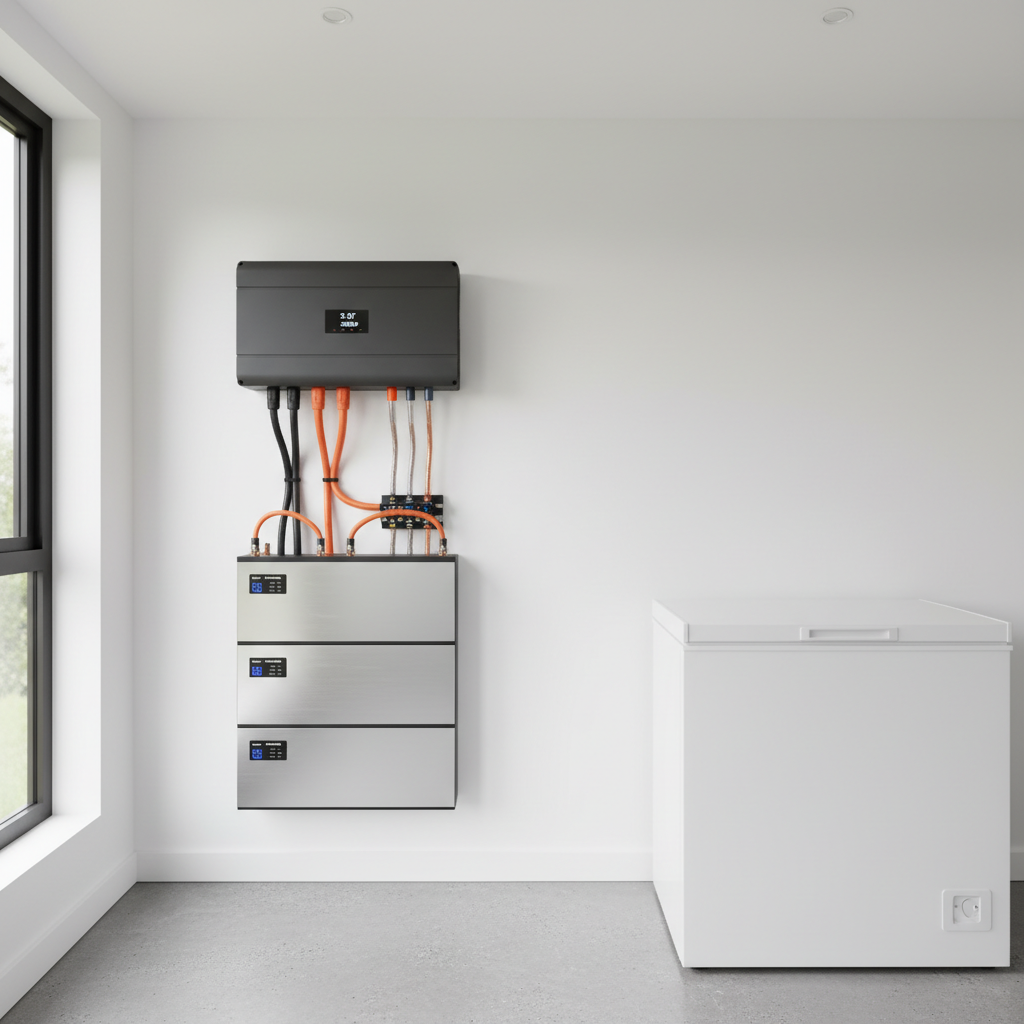
Why this question matters in Nigeria now
For the average Nigerian household or small-scale frozen food business, the deep freezer is the most critical asset. Unlike lighting or entertainment, a freezer represents significant capital in the form of perishable inventory. With the Nigerian Electricity Regulatory Commission (NERC) recently approving tariff hikes for Band A customers and the persistent instability of the national grid managed by the Transmission Company of Nigeria (TCN), relying solely on the grid is no longer a viable strategy for food security.
Furthermore, the volatility of Premium Motor Spirit (PMS) and diesel prices has made the traditional backup generator economically unsustainable. Transitioning to Lithium Iron Phosphate (LiFePO4) technology is the modern standard for energy independence. Unlike lead-acid or AGM batteries, LiFePO4 offers a higher depth of discharge (DoD), longer cycle life, and thermal stability—crucial for the harsh West African climate. Sizing your system correctly ensures you do not overspend on capacity you don't need or, worse, undersize a system that fails during a 48-hour blackout.
By the numbers: According to ESMAP (Energy Sector Management Assistance Program), Nigerian businesses lose approximately $29 billion annually due to unreliable power. For a small business owner, a single 12-hour outage can result in a 100% loss of frozen inventory if the battery storage is not sized to handle the compressor's inductive start-up load.
Real-world load profile
To understand how to size a LiFePO4 battery storage for deep freezer units, we must first analyze the consumption pattern. A deep freezer does not draw its rated power continuously. Instead, it cycles its compressor on and off based on the internal thermostat and ambient temperature. In Nigeria, where ambient temperatures often exceed 30°C, compressors run more frequently than in temperate climates.
| Appliance Type | Rated Power (Watts) | Surge/Startup Power (Watts) | Daily Duty Cycle (Est.) | Total Daily Wh |
|---|---|---|---|---|
| Small Chest Freezer (150L) | 80W - 120W | 600W - 900W | 50% (12 hours) | 1,200Wh |
| Medium Deep Freezer (300L) | 150W - 250W | 1,200W - 1,800W | 60% (14.4 hours) | 2,880Wh |
| Large Double Door Freezer | 300W - 500W | 2,400W - 4,000W | 70% (16.8 hours) | 6,720Wh |
| Inverter-Type Freezer (250L) | 60W - 150W | 150W - 200W | 50% (12 hours) | 1,000Wh |
It is important to note the difference between standard compressors and Inverter Technology compressors. Standard compressors have a massive "LRA" (Locked Rotor Amps) requirement, often 5 to 8 times the running current. This surge must be accounted for in the inverter selection, while the total Wh (Watt-hours) dictates the battery capacity.
Inverter sizing math
When sizing an inverter for a deep freezer, we focus on the peak surge. If your freezer is rated at 200W, its startup surge might hit 1,600W. If you use a cheap, low-frequency inverter with poor surge handling, the system will trip every time the thermostat calls for cooling.
At Maypatronic, we recommend looking at the Power Factor (PF) of the inverter. Most modern solar inverters have a PF of 0.8 or 1.0. A 3kVA inverter with a 0.8 PF provides 2,400W of continuous power. For a large deep freezer, a 3kVA system is usually the minimum to handle the inductive kick without stressing the electronics.
Engineer's note — Maypatronic Solar Engineering Team: "We often see clients try to run deep freezers on 1kVA modified sine wave inverters. This is a mistake. The inductive load of a compressor requires a Pure Sine Wave to operate efficiently. A modified wave will cause the compressor motor to run hot, significantly shortening the lifespan of both the freezer and the inverter."
If you are unsure of your specific appliance requirements, our Solar Load Estimator can help calculate your total peak and continuous load requirements.
LiFePO4 battery sizing math
LiFePO4 batteries are sized in Amp-Hours (Ah) and Voltage (V), which combine to give Watt-Hours (Wh). The formula is: Wh = Ah x V.
To calculate the required capacity for a deep freezer, follow these four steps:
- Determine Autonomy: How many hours or days do you need to run the freezer without sun or grid? (Standard is 24 hours).
- Account for Depth of Discharge (DoD): While LiFePO4 can go to 100%, for maximum longevity (6,000+ cycles), we size for 80% DoD.
- Calculate Inverter Efficiency: Inverters are not 100% efficient. We assume a 90% Round Trip Efficiency (RTE).
- Apply Temperature De-rating: In hot climates like Lagos or Kano, battery efficiency can fluctuate, though LiFePO4 is resilient.
Example Calculation: A 250L freezer consumes 2,500Wh per day. Required Capacity = (2,500Wh / 0.8 DoD) / 0.9 Efficiency = 3,472Wh. At a 24V system voltage: 3,472Wh / 25.6V = 135Ah.
Therefore, a 24V 150Ah LiFePO4 battery or a 48V 100Ah battery would be the ideal choice for this single appliance. Using a smaller 12V 100Ah (1.2kWh) lead-acid battery would result in a total system failure by midnight during a grid outage.
By the numbers: According to BloombergNEF, the cost of Lithium-ion battery packs has fallen 82% since 2012. In the Nigerian context, even though the upfront cost is higher than lead-acid, the 'Cost Per Cycle' is approximately 3 times cheaper over a 10-year period.
Solar PV array sizing and roof footprint
Battery storage is only half the equation. You must be able to recharge that storage during the limited daylight hours available in West Africa. According to NIMET (Nigerian Meteorological Agency), Nigeria averages about 4.5 to 6 peak sun hours (PSH) per day, depending on the latitude and season (Harmattan dust can reduce this significantly).
To recharge a 3,500Wh battery bank while simultaneously running the freezer during the day, your solar array must produce roughly 5,000Wh daily.
Array Size = 5,000Wh / 4.5 PSH = 1,111W.
You would need approximately three 450W-550W high-efficiency mono-perc solar panels.
Roof Footprint: A standard 550W panel is roughly 2.3 square meters. A 3-panel array requires approximately 7-8 square meters of clear, unshaded roof space. It is critical to ensure panels are cleaned regularly, especially in the northern regions, as dust accumulation can drop output by 30%.
Indicative cost breakdown in NGN
Investing in a dedicated system for a deep freezer is an investment in food security. Below is an indicative breakdown of a mid-range system (comparable to our /bundles#silver package) designed to support a medium-to-large deep freezer and basic lighting.
| Component | Specifications | Estimated Price (NGN) |
|---|---|---|
| Inverter | 3kVA Pure Sine Wave (24V) | ₦350,000 - ₦450,000 |
| Battery | 24V 150Ah LiFePO4 (LFP) | ₦900,000 - ₦1,200,000 |
| Solar Panels | 3 x 450W Mono-Perc | ₦450,000 - ₦550,000 |
| Charge Controller | 60A MPPT (Integrated or External) | Included in Inverter Price |
| Protection/Cabling | DC Breakers, Surge Protectors, 6mm² Cable | ₦150,000 - ₦200,000 |
| Total Estimated | Full Installation | ₦1.8M - ₦2.4M |
Note: Prices are subject to exchange rate fluctuations and specific brand selections. For a custom quote, visit our Contact Page.
ROI vs diesel generator
While ₦2 million may seem steep, the Return on Investment (ROI) compared to a small "I-pass-my-neighbor" or a 5kVA diesel generator is startling.
A 5kVA generator consumes roughly 1.2 liters of fuel per hour. To run a freezer 15 hours a day (the time the grid is typically off in many areas), you consume 18 liters daily. At ₦1,200 per liter (Diesel/PMS), that is ₦21,600 per day or ₦648,000 per month.
Engineer's note — Maypatronic Solar Engineering Team: "When we perform audits for Business Clients, we find that a solar-plus-storage system for refrigeration usually pays for itself within 14 to 18 months. Beyond that, the energy is effectively free for the remaining 8-10 years of the battery's lifespan. Generators, conversely, become more expensive every year due to mechanical wear and fuel inflation."
Installation, warranty, and what Maypatronic includes
When you purchase a system from Maypatronic, we don't just ship boxes. A deep freezer system requires specific configuration. We set the Bulk, Float, and Cut-off voltages on the inverter to match the specific BMS (Battery Management System) of the LiFePO4 cells. Incorrect settings are the leading cause of premature battery failure in Nigeria.
Our /bundles#silver package is specifically designed for high-availability domestic loads. It includes a 5-year pro-rated warranty on Lithium batteries and a 24-month warranty on inverters. We also provide remote monitoring options so you can check your freezer's power status from your smartphone anywhere in the world.
For those looking for smaller solutions, our Shop features portable power stations, but for a permanent deep freezer setup, a fixed installation is always recommended for safety and efficiency.
FAQ
Can I use a single 12V LiFePO4 battery for my freezer?
While a 12V 100Ah LiFePO4 battery can store 1.2kWh, it is often insufficient for a standard deep freezer's daily cycle (which is usually >2kWh). Furthermore, the high surge current of a freezer compressor can trigger the BMS protection on smaller 12V batteries, causing the system to shut down. We recommend at least a 24V system for refrigeration.
How long will a 100Ah Lithium battery run a deep freezer?
A 100Ah 24V LiFePO4 battery (2.56kWh) will typically run a modern medium-sized chest freezer for about 18-22 hours without any solar or grid input, assuming no other loads are connected. A 100Ah 12V battery will only last about 8-9 hours.
Does the brand of freezer matter for battery sizing?
Yes, significantly. Freezers with "Inverter Technology" (like those from LG, Samsung, or Haier Thermocool's high-end line) have a soft-start mechanism. They don't have the 8x surge current, allowing you to use a smaller, less expensive inverter. If you are buying a new freezer to go with your solar system, always choose an Inverter-type model.
Can I mix my old Lead-Acid batteries with new LiFePO4 batteries?
No. Never mix different battery chemistries or even different brands/ages of the same chemistry. The charging profiles are vastly different. Doing so will likely result in the destruction of the lead-acid battery and could potentially damage the BMS on your new Lithium battery.
How do I maintain my LiFePO4 battery for the freezer?
LiFePO4 batteries are virtually maintenance-free. However, you should ensure they are kept in a well-ventilated, cool area. Avoid keeping them in the same small enclosure as the freezer itself, as the heat exhausted by the freezer's condenser coils can raise the ambient temperature and reduce battery efficiency.
What happens during the rainy season when there is no sun?
This is where sizing for 'autonomy' becomes important. By sizing the battery for 80% DoD and including a slightly larger PV array, you can still harvest enough diffuse light to keep the battery topped up. Our Silver Bundle is balanced to provide a buffer for 1-2 days of poor weather.
- Electrical servicesCertified installation & audits
- Scrap battery buy-backSame-day pickup + payment
- AI sizing estimatorkVA / kWh in 60 seconds
- Solar bundles5 pre-engineered tiers
- B2B solutionsCommercial & industrial
- Talk to an engineerFree consultation