How to Size a LiFePO4 Battery Storage for Office Server Rack
Learn how to calculate the exact LiFePO4 battery capacity and solar PV requirement needed to keep your office server rack online 24/7 during grid instability.
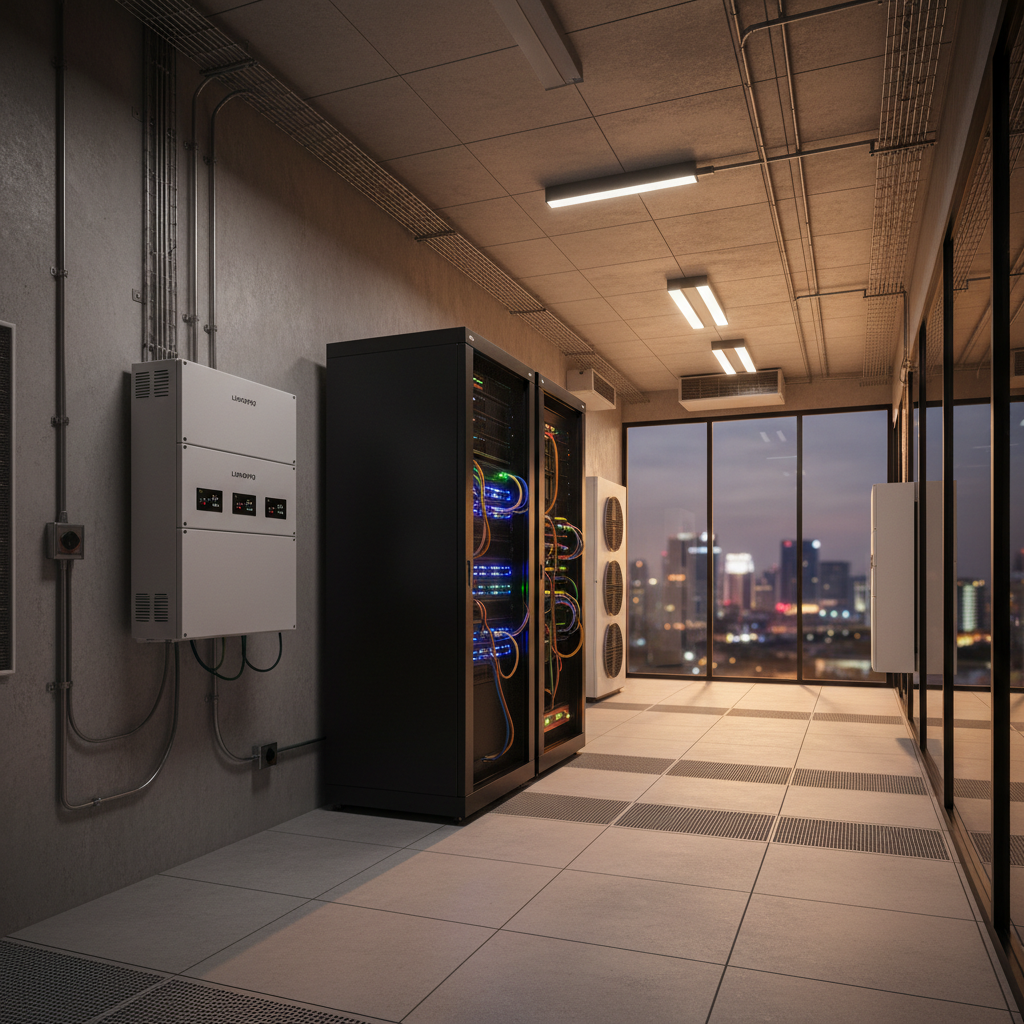
Why Sizing a LiFePO4 Battery Matters for Nigerian Offices
In the Nigerian commercial landscape, power is no longer an operational expense; it is a strategic risk. With the Nigerian Electricity Regulatory Commission (NERC) implementing Multi-Year Tariff Orders (MYTO) that have seen Band A customers facing significant rate hikes, and the persistent instability of the national grid managed by the Transmission Company of Nigeria (TCN), businesses can no longer rely on 'NEPA' for critical IT infrastructure.
For an office server rack, downtime is not just an inconvenience; it is data corruption, lost man-hours, and client distrust. Traditional Lead-Acid or AGM batteries, which were the standard for years, fail prematurely in the Nigerian heat and lack the cycle life to handle the frequent discharge cycles necessitated by daily outages. This is where Lithium Iron Phosphate (LiFePO4) technology has revolutionized the market. However, incorrectly sizing these systems leads to two scenarios: over-investment in unused capacity or system shutdowns during peak load.
By the numbers: According to the International Energy Agency (IEA), Nigeria has the highest deficit of electricity access globally, with the commercial sector losing an estimated $29 billion annually due to power unreliability. This makes local storage efficiency the primary determinant of business continuity.
Real-World Load Profile: Mapping the Server Rack
Before purchasing a single battery, you must audit the rack. A common mistake is looking at the 'label rating' on the back of a server (e.g., 750W). These represent the maximum power supply rating, not the actual consumption. Active servers typically run at 30% to 60% of their rated power.
| Equipment Type | Typical Qty | Average Load (Watts) | Total Continuous Load |
|---|---|---|---|
| Dell PowerEdge/HP ProLiant Server | 2 | 250W | 500W |
| CISCO Network Switch (POE) | 1 | 80W | 80W |
| Hardware Firewall (Fortigate/Sophos) | 1 | 45W | 45W |
| NAS Storage (4-Bay) | 1 | 60W | 60W |
| NVR for CCTV (16-Channel) | 1 | 100W | 100W |
| Monitor & KVM Switch | 1 | 30W | 30W |
| Total Estimated Base Load | 815W |
To ensure 24/7 uptime, this 815W load must be maintained during both the night and throughout the unpredictable 'Dumsor' periods common in the region. If you are integrating this into our [/bundles#gold](Gold Bundle), we typically advise a buffer for cooling fans which add another 100W to the thermal management of the rack.
Inverter Sizing Math: kVA, kW, and Power Factor
Many vendors in Nigeria sell inverters based on kVA (Kilo-Volt-Amperes), but servers consume kW (Kilowatts). The difference is the Power Factor (PF). Most modern IT equipment has an active PFC, giving it a PF close to 0.9 or 1.0. However, the inverter itself has a rating.
If you have a 5kVA inverter with a PF of 0.8, your actual usable power is 4kW (4000W). For an 815W server load, a 5kVA inverter might seem like overkill, but you must account for 'Inrush Current' from cooling fans and the necessity of keeping the inverter operating in its 'efficiency sweet spot' (typically 40-60% load).
Engineer's note — "At Maypatronic, we emphasize the 'De-rating Factor.' In the high-ambient temperatures of Lagos or Kano, an inverter’s internal components generate heat. Operating at near-maximum capacity 24/7 in an uncooled server room will trigger thermal shutdowns. Always size your inverter so your continuous load is no more than 70% of its rated capacity."
LiFePO4 Battery Sizing Math: The Depth of Discharge Advantage
LiFePO4 batteries are superior for server racks because of their 80% to 90% Depth of Discharge (DoD) without significant degradation. Unlike lead-acid batteries that drop voltage quickly, LiFePO4 maintains a flat voltage curve, which is critical for sensitive IT power supplies.
To calculate the required battery capacity (in Amp-Hours or Kilowatt-Hours), use the following formula:
Total Energy Needed (Wh) = (Load in Watts × Backup Hours Required) / (Inverter Efficiency × DoD)
For a server rack pulling 815W that needs to survive a 10-hour outage (covering a work day or a long night gap):
- Load: 815W
- Runtime: 10 Hours
- Gross Capacity Needed: 8,150Wh (8.15kWh)
- Real-world Capacity (Accounting for 90% Efficiency): 8,150 / 0.9 = 9,055Wh.
In this scenario, a 10kWh LiFePO4 bank (e.g., two 5.12kWh modules) is the minimum requirement for a 10-hour buffer. Use our [/estimator](Solar Load Estimator) to tweak these variables for your specific office uptime requirements.
By the numbers: According to BloombergNEF, while LiFePO4 upfront costs are higher, the Levelized Cost of Storage (LCOS) is 40% lower than lead-acid over a 5-year period in high-cycle environments like West Africa due to the 4,000+ cycle life.
Solar PV Array Sizing and Roof Footprint
To keep those batteries charged without relying solely on the grid or a generator, a Solar PV array is required. In Nigeria, we benefit from an average of 4.5 Peak Sun Hours (PSH). However, during the Harmattan season, dust accumulation on panels can reduce efficiency by 15-25%.
To recharge a 10kWh battery bank while simultaneously powering an 815W load during the day, your solar array must produce significantly more than the load.
- Daily Load Requirement: 815W × 24h = 19.56kWh
- Inverter/Charging Losses: ~15%
- Total Generation Goal: 22.5kWh per day.
- Required PV Size: 22.5kWh / 4.5 PSH = 5kWp of solar panels.
A 5kWp array typically consists of 9 to 10 high-efficiency 550W mono-crystalline panels. This requires approximately 25 to 30 square meters of clear roof space, preferably south-facing to maximize southern hemisphere irradiation as suggested by IRENA's Africa guidelines.
Indicative Cost Breakdown for a Server Backup System (NGN)
Prices fluctuate based on the NGN/USD exchange rate, but the following table provides a structural overview of a professional installation for a mid-sized server rack.
| Component | Quality Tier | Estimated Price Range (NGN) |
|---|---|---|
| 5kVA Pure Sine Wave Hybrid Inverter | Industrial Grade | ₦1,200,000 - ₦1,600,000 |
| 10kWh LiFePO4 Battery Bank (Grade A) | Rack Mount | ₦3,800,000 - ₦5,000,000 |
| 5.5kWp Solar Array (Tier 1 Mono) | High Efficiency | ₦1,800,000 - ₦2,400,000 |
| DC/AC Protection + Rack Cabinet | Schneider/ABB | ₦450,000 - ₦700,000 |
| Professional Installation & Cabling | Certified | ₦300,000 - ₦500,000 |
For businesses looking for a pre-configured solution that includes these premium components with a warranty, our [/bundles#platinum](Platinum Bundle) offers the redundancy required for Tier 2 data environments.
ROI vs Diesel Generator: The Financial Case
With PMS and Diesel prices in Nigeria soaring, the 'Payback Period' for a solar/battery system for a server rack has dropped from 5 years to approximately 18–24 months.
Engineer's note — "A 10kVA diesel generator consumes roughly 1.5 to 2.5 liters per hour under load. Running a generator for 10 hours a day to keep a server rack online can cost upwards of ₦25,000 daily in fuel alone, excluding servicing and oil changes. A LiFePO4 system has zero daily fuel cost and eliminates the noise/vibration that damages mechanical hard drives in older servers."
Furthermore, the World Bank's ESMAP program highlights that distributed solar is the most resilient path for African businesses to mitigate the unreliability of centralized grids. By eliminating the 'crashing' of servers during the transition from grid to Gen-set (which even some cheap UPS systems fail to catch), you extend the lifespan of your IT hardware by years.
Installation, Warranty, and What Maypatronic Includes
When we deploy a system for an office server rack, we don't just 'drop and go.' A server room environment requires specific considerations:
- Thermal Regulation: We ensure the LiFePO4 batteries are placed in well-ventilated areas, as 25°C is the ideal operating temperature for longevity.
- Monitoring: Our systems include Wi-Fi/GPRS loggers that allow the IT Manager to see battery health and load via a mobile app.
- Automatic Changeover: Zero-millisecond transfer time is critical. Our hybrid inverters act as a massive online UPS, ensuring the servers never 'blink' during a power cut.
- Warranty: We provide comprehensive warranties on our [/shop](Solar Shop) components, with 5 years on LiFePO4 cells and 2 years on inverter electronics.
If you are unsure whether your current server load fits the /bundles#silver or /bundles#gold tiers, we recommend booking a site audit via our [/contact](Contact Page) to get a precise measurement of your rack's current draw using Fluke power quality analyzers.
FAQ: Sizing Storage for Servers
How long do LiFePO4 batteries last in a 24/7 server environment?
With proper sizing and temperature control, a high-quality LiFePO4 battery will last 10 years (approx 4,000-6,000 cycles) even with daily discharges. This is 5x longer than the best deep-cycle gel batteries found in most Nigerian markets.
Can I mix old and new LiFePO4 batteries as my server rack grows?
While possible with some brands, it is generally discouraged unless using a battery management system (BMS) that supports parallel communication between different-aged packs. It is better to size for 20% future growth today.
Does the Harmattan dust affect my solar charging efficiency?
Yes. In Northern Nigeria and even Lagos during January, dust can reduce output by 30%. We recommend a bi-weekly cleaning schedule for office arrays to ensure your batteries reach 100% SoC (State of Charge) by 3:00 PM.
Is a 5kVA inverter enough for a full server rack?
It depends on the 'U' count and density. A half-rack (22U) usually draws 1kW-2kW, which a 5kVA inverter handles easily. A full 42U rack running high-performance computing (AI/Rendering) can pull 10kW+, requiring a much larger 15kVA system.
Why not just use a standard UPS?
Standard UPS units (APC, CyberPower) are designed for 'graceful shutdown' (10-15 minutes of runtime). They are not designed for deep-cycle daily use. A LiFePO4 energy storage system is designed for 'continuous operation,' keeping you running for hours, not minutes.
Do I need a special rack for the batteries?
LiFePO4 batteries come in wall-mounted or rack-mounted (3U/5U) form factors. We usually recommend rack-mounted versions for server rooms so they can sit at the bottom of your existing 19-inch cabinet, keeping the footprint clean and professional. Explore our [/business](Business Solutions) section for custom rack integration examples.
- Electrical servicesCertified installation & audits
- Scrap battery buy-backSame-day pickup + payment
- AI sizing estimatorkVA / kWh in 60 seconds
- Solar bundles5 pre-engineered tiers
- B2B solutionsCommercial & industrial
- Talk to an engineerFree consultation