Solar Charge Controller Prices in Lagos Nigeria 2026: A Buyer's Guide
Discover the latest solar charge controller prices in Lagos for 2026. Learn how to size PWM and MPPT controllers for your gold solar bundle and maximize ROI.
Why This Question Matters in Nigeria Now
As we navigate the energy landscape of 2026, the cost of power in Nigeria has reached a critical inflection point. With the full implementation of the Electricity Act 2023, which devolved power to states, and the continued upward trajectory of Band A tariffs from NERC, the solar charge controller has emerged as the most critical 'brain' in a renewable energy setup. In Lagos, where commercial and residential demand often outstrips the supply from Eko and Ikeja DisCos, the solar charge controller is no longer just a component; it is the gatekeeper of battery longevity and system efficiency.
By the numbers: As of early 2026, the average cost of diesel in Nigeria has stabilized at approximately 1,450 NGN per liter, while grid tariffs for premium customers exceed 210 NGN/kWh. This has shortened the payback period for a high-quality MPPT controller to less than 14 months. (Source: NBS Nigeria)
The conversation around solar charge controller prices in Lagos Nigeria 2026 is driven by two factors: the transition from lead-acid to LiFePO4 batteries and the fluctuating exchange rate of the Naira. Buyers are no longer asking for the cheapest option but for the unit that provides the highest energy harvest during the dusty Harmattan months when PV efficiency drops.
Real-World Load Profile
To understand the pricing of a charge controller, we must first define the load it supports. A typical mid-scale Nigerian home or small office, often serviced by our /bundles#gold package, requires a system that can handle both inductive loads (ACs, pumps) and sensitive electronics.
| Appliance Type | Rating (Watts) | Quantity | Daily Use (Hours) | Daily Consumption (Wh) |
|---|---|---|---|---|
| Inverter AC (1.5 HP) | 1,100 | 1 | 6 | 6,600 |
| LED Television (55") | 120 | 1 | 8 | 960 |
| Refrigerator/Freezer | 150 | 1 | 24 (Cycling) | 1,800 |
| LED Lighting Points | 10 | 15 | 6 | 900 |
| Laptops/Workstations | 65 | 3 | 8 | 1,560 |
| Total Daily Demand | 11,820 Wh (11.82 kWh) |
Selecting a charge controller without this data is a recipe for system failure. In 2026, the focus has shifted toward 48V architectures to minimize current loss and cable costs.
Inverter Sizing Math
When choosing a charge controller, you must ensure it aligns with your inverter's DC input. A 5kVA inverter is the standard for the Gold bundle. However, engineering precision requires us to look at the Power Factor (PF).
Engineer's note — Always distinguish between kVA and kW. A 5kVA inverter with a PF of 0.8 only provides 4kW of real power. If your charge controller allows the battery to dip too low due to poor harvesting, the inverter will struggle to handle the inrush current of a fridge compressor. We recommend sizing your MPPT to provide 1.2x the required charging current of the battery bank to ensure the inverter never starves. — Maypatronic Solar Engineering Team
In Lagos, heat derating is a significant factor. A charge controller rated for 60A at 25°C may only deliver 45A in a poorly ventilated Lagos battery room where temperatures hit 40°C. This physical reality dictates that a high-quality MPPT with a robust heat sink will always carry a premium price over generic alternatives.
LiFePO4 Battery Sizing Math
In 2026, Lithium Iron Phosphate (LiFePO4) is the industry standard in Nigeria. Unlike the old tubular batteries, LiFePO4 requires specific charging profiles that only advanced MPPT controllers can provide. The International Energy Agency (IEA) has noted that battery management systems (BMS) are now the primary drivers of solar hardware costs in Sub-Saharan Africa.
By the numbers: A 10kWh LiFePO4 battery bank operating at 80% Depth of Discharge (DoD) provides 8kWh of usable energy. With a Round Trip Efficiency (RTE) of 95%, your solar charge controller must harvest at least 8.5kWh daily just to break even with your consumption. (Source: BloombergNEF)
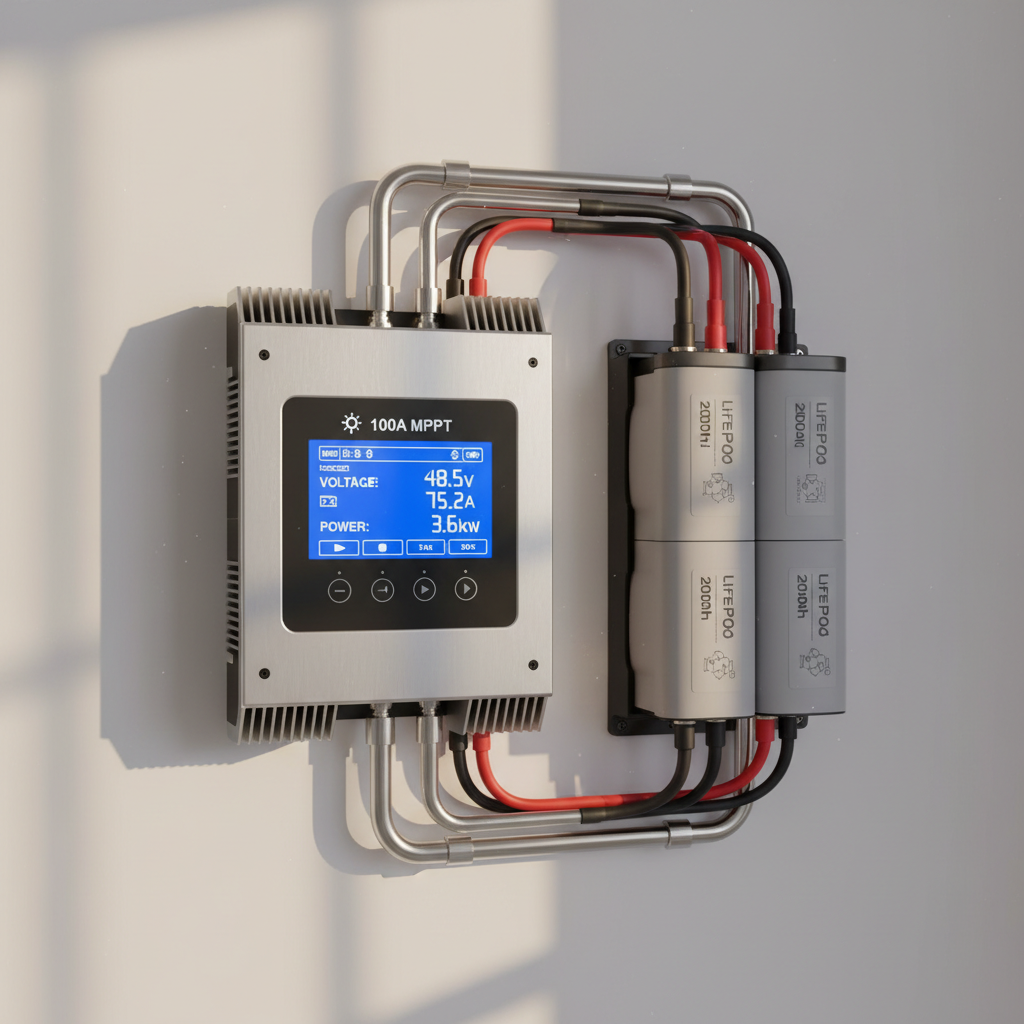
For a 48V system, an 80A or 100A MPPT is required to push the necessary current into the lithium cells during the peak sun hours (typically 10:00 AM to 3:00 PM in Lagos). Cheap PWM controllers cannot communicate with lithium BMS, often leading to premature cell death—a mistake that costs ten times the price of a good controller.
Solar PV Array Sizing and Roof Footprint
To feed a 100A controller, your PV array must be sized according to the Peak Sun Hours (PSH) in Nigeria. According to NIMET, Lagos averages 4.5 PSH annually, though this drops significantly during the rainy season and Harmattan.
To generate 12kWh of energy daily (accounting for system losses):
12,000Wh / 4.5 PSH / 0.85 (Efficiency factor) = 3,137 Watts of PV panels.
Using 550W high-efficiency Mono-PERC panels, you would need 6 panels. This array requires approximately 18 to 20 square meters of roof space. The charge controller must be able to handle the Open Circuit Voltage (Voc) of these panels in series. A controller with a 150V or 250V limit allows for longer strings, which reduces the cost of DC combiner boxes and thick copper cabling.
Indicative Cost Breakdown in NGN
The following table reflects the estimated solar charge controller prices in Lagos Nigeria 2026 for high-tier components found in our /shop and /bundles.
| Controller Type | Rating | Estimated Price (NGN) | Ideal Application |
|---|---|---|---|
| Basic PWM | 30A - 60A | 45,000 - 95,000 | Small 12V/24V lighting systems |
| Standard MPPT | 40A | 180,000 - 250,000 | 2kVA systems, 24V Lithium |
| Professional MPPT | 60A | 350,000 - 520,000 | 5kVA systems, Gold Bundle |
| Industrial MPPT | 100A+ | 650,000 - 950,000 | 10kVA+ systems, Platinum/Diamond |
| Hybrid Inverter (Integrated) | 5kW - 10kW | 1,200,000 - 2,800,000 | All-in-one residential solutions |
Note: Prices are subject to volatility based on the Central Bank of Nigeria (CBN) FX rates and import duties at the Apapa/Tin Can ports.
ROI vs Diesel Generator
While the upfront cost of a 60A MPPT controller (approx. 450,000 NGN) may seem high, the comparison to a petrol or diesel generator is stark. A 5kVA generator consumes roughly 1.5 liters of fuel per hour. Over a year of 8-hour daily use, the fuel cost alone exceeds 4.2 million NGN.
Engineer's note — In our field audits across Ikeja and Lekki, we find that systems using high-end MPPT controllers harvest 25-30% more energy than those using PWM. That 'extra' 30% is essentially free fuel. When you factor in the zero-maintenance cost of a solid-state controller versus the filters, oil, and spark plugs of a generator, the ROI is undeniable. We encourage users to use our /estimator to see their specific savings. — Maypatronic Solar Engineering Team
By maximizing the harvest from the sun, the solar charge controller ensures that the expensive lithium battery is fully cycled daily, preventing the need for grid top-ups or generator runs during the night.
Installation, Warranty, and What Maypatronic Includes
Buying a solar charge controller in Lagos is only half the battle; the other half is professional calibration. A controller set to the wrong charging voltage for a LiFePO4 battery will trigger the BMS to shut down, or worse, degrade the cells. At Maypatronic, we don't just sell hardware; we provide energy security.
Our /bundles#gold package includes an industrial-grade MPPT controller with a minimum 2-year manufacturer warranty. Our installation process involves:
- Thermal Imaging: We check all connections to ensure no hotspots are present.
- Firmware Updates: Ensuring the controller has the latest charging algorithms for modern battery chemistries.
- Remote Monitoring: Integrating the controller with your home Wi-Fi so you can track harvest via your smartphone.
For larger commercial installs, visit our /business page to see how we scale these systems for factories and office complexes. If you are ready to upgrade your current system or start fresh, you can /contact our Lagos office for a site survey.
FAQ
Why are MPPT controller prices so much higher than PWM?
MPPT (Maximum Power Point Tracking) uses a DC-to-DC transformer to convert excess voltage into extra current. It is an electronic device with complex logic, whereas PWM is essentially a switch. MPPT is up to 30% more efficient, which justifies the 4x price difference in the Lagos market.
Can I use a 60A controller for a 10kVA system?
Generally, no. A 10kVA system usually requires more solar input than a single 60A controller can handle at 48V. You would typically need two 80A controllers or a large industrial 150A unit to manage the PV array required for a system of that size.
How does the Harmattan dust affect my charge controller?
Dust reduces the voltage and current coming from your panels. A high-quality controller will attempt to find the new maximum power point even in low-light/dusty conditions. However, you must still clean your panels. The controller's internal cooling fan should also be checked for dust buildup to prevent overheating.
Is it better to buy a separate controller or a hybrid inverter?
Hybrid inverters include a built-in charge controller. This saves space and simplifies installation. However, standalone controllers are often more robust and easier to replace if one component fails. For mission-critical systems, we often recommend separate components.
Do you offer a warranty on controllers bought in Lagos?
Yes, all controllers purchased through our /shop or installed in our bundles come with a warranty. We handle the local RMA process so you don't have to deal with overseas manufacturers.
Can I mix different brands of charge controllers on the same battery bank?
It is possible if they are set to the exact same charging parameters, but it is not recommended. Different brands may 'fight' each other as they reach the float stage. It is best to use identical units and synchronize them if the brand supports parallel communication.
- Electrical servicesCertified installation & audits
- Scrap battery buy-backSame-day pickup + payment
- AI sizing estimatorkVA / kWh in 60 seconds
- Solar bundles5 pre-engineered tiers
- B2B solutionsCommercial & industrial
- Talk to an engineerFree consultation