Solar Inverter Prices in Nigeria 2026: The Comprehensive Buyer's Guide
Discover the latest solar inverter prices in Nigeria for 2026, featuring expert engineering analysis on load sizing, battery technology, and ROI against rising grid tariffs.
Why Solar Inverter Prices in Nigeria 2026 Matter Now
As we navigate the energy landscape of 2026, the conversation around power in Nigeria has shifted from a luxury to a fundamental economic necessity. With the Nigerian Electricity Regulatory Commission (NERC) implementing multi-year tariff orders that reflect the true cost of generation and gas-to-power constraints, grid electricity is no longer the cheap default. For consumers in Band A feeders, the cost per kilowatt-hour (kWh) has reached a point where decentralized solar power is not just an environmental choice, but a superior financial hedge.
Understanding Solar Inverter Prices in Nigeria 2026 requires more than a cursory glance at a price tag. It requires an analysis of global supply chain stability, the fluctuations of the Naira against the USD, and the technological leap from traditional Lead-Acid systems to high-frequency LiFePO4-integrated hybrid systems. The International Renewable Energy Agency (IRENA) notes that while global hardware costs have stabilized, local logistics and duty structures in West Africa remain the primary variables in end-user pricing.
By the numbers: According to data from the National Bureau of Statistics (NBS) and energy market trackers, the average Nigerian household in Band A saw a 240% increase in energy expenditure between 2024 and 2026, making the 3-year ROI on solar systems the most aggressive in the continent's history.
Real-World Load Profile Analysis
Before discussing the naira value of a 5kVA or 10kVA system, we must define what these systems actually power. A common mistake in the Nigerian market is sizing an inverter based on the sum of all appliance labels rather than the coincident peak load and surge requirements.
For a typical 4-bedroom bungalow in Lagos or Abuja, the load profile is bifurcated into 'Essential' and 'Heavy' loads. Our /bundles are specifically designed to manage these transitions using smart load shedding or dedicated sub-panels.
| Appliance Type | Rated Wattage | Typical Quantity | Hourly Consumption (Wh) |
|---|---|---|---|
| LED Lighting Points | 10W | 15 | 150 |
| Inverter Refrigerator | 150W | 1 | 150 |
| Standing Fans (DC) | 35W | 4 | 140 |
| Smart TV (55 inch) | 120W | 2 | 240 |
| Laptop/Workstation | 65W | 2 | 130 |
| Pressure Pump (0.5HP) | 375W | 1 | 375 (Intermittent) |
| Inverter AC (1.5HP) | 1,200W | 1 | 800 (Cycling) |
Total Essential Base Load: ~1.2kW - 2.0kW. This profile suggests that a 5kVA system (operating at a 0.8 Power Factor, providing 4kW continuous) is the sweet spot for the modern Nigerian professional working from home.
Inverter Sizing Math and Engineering Standards
The "kVA" rating on an inverter is often misunderstood. In engineering terms, kVA is Apparent Power, while kW is Real Power. The relationship is governed by the Power Factor (PF). In 2026, top-tier brands supplied by Maypatronic utilize a PF of 1.0 (Unity), meaning a 5kVA inverter provides 5kW. However, budget-grade inverters still operate at 0.8 PF.
Engineer's note — Maypatronic Solar Engineering Team: "Always verify the 'Surge Capacity.' A 5kVA inverter might handle 5,000W continuously, but a 1.5HP Air Conditioner compressor can pull up to 3 times its running current during startup for a few milliseconds. If your inverter lacks a 200% surge rating for at least 5 seconds, you will experience frequent 'Overload' shutdowns, which shorten the lifespan of the MOSFETs."
When calculating your needs on our /estimator, we factor in these inductive surges. For a system to remain healthy, we recommend a maximum continuous load of 70% of the inverter's rated capacity. This headroom accounts for the high ambient temperatures in Nigeria, which can exceed 40°C, leading to thermal derating of the power electronics.
LiFePO4 Battery Sizing Math
The most significant shift in Solar Inverter Prices in Nigeria 2026 is the total dominance of Lithium Iron Phosphate (LiFePO4) batteries. Unlike the old Tubular or AGM batteries that could only be discharged to 50% without permanent damage, LiFePO4 allows for 80% to 95% Depth of Discharge (DoD).
To calculate the required battery capacity (C), we use the formula:
C = (Daily Load in Wh × Days of Autonomy) / (System Voltage × DoD)
For a 10kWh daily requirement at 48V with 80% DoD:
C = (10,000Wh × 1) / (48V × 0.8) = 260Ah
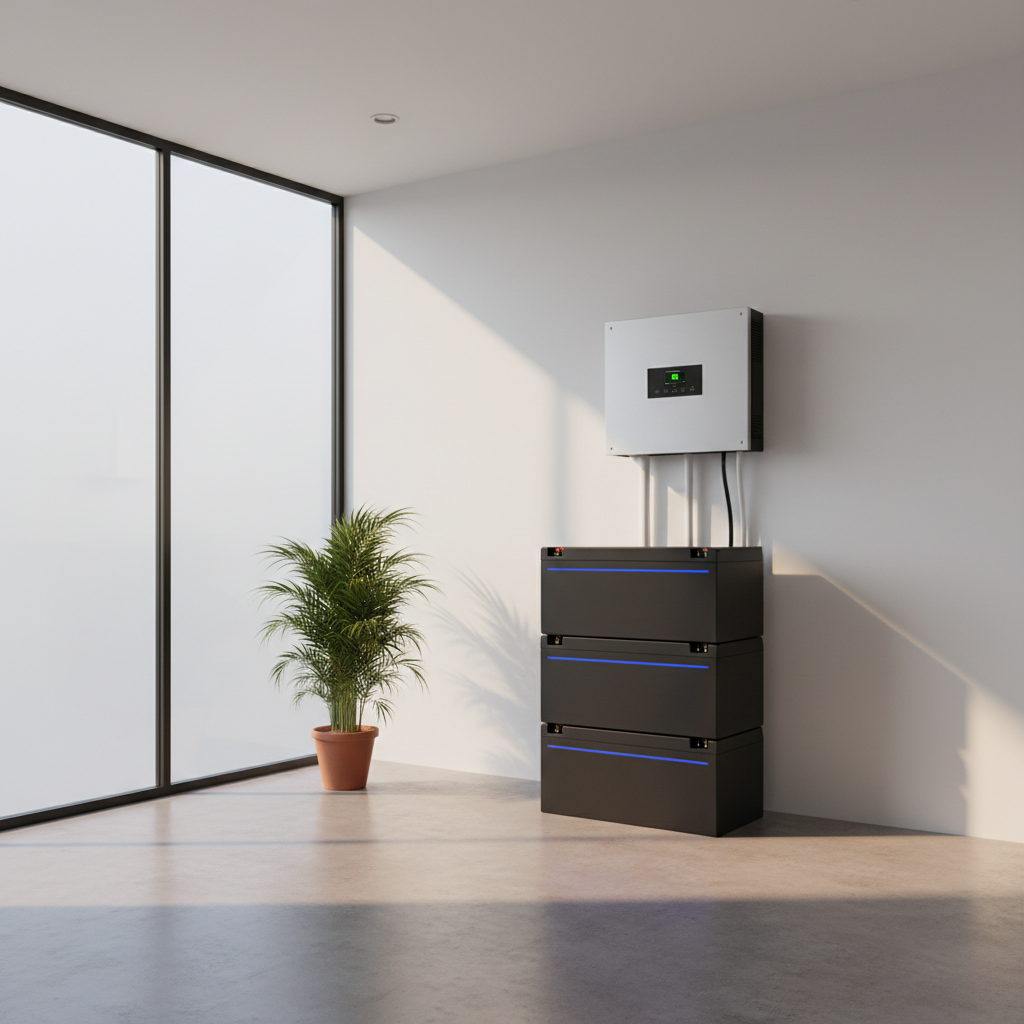
In 2026, a 5.12kWh wall-mounted lithium module is the industry standard. Pairing two of these modules gives a household 10.24kWh of usable energy, enough to carry the essential loads through the night without grid or generator support. According to the World Bank ESMAP, the levelized cost of storage (LCOS) for lithium has now fallen below the cost of maintaining a diesel generator over a 5-year cycle in emerging markets.
By the numbers: LiFePO4 batteries offer 4,000 to 6,000 cycles at 80% DoD. In contrast, lead-acid batteries provide only 500-800 cycles. While the upfront price of lithium is 2.5x higher, the cost per cycle is approximately 60% lower over the battery's lifespan.
Solar PV Array Sizing and Roof Footprint
Nigeria's geography offers an excellent solar resource, averaging 4.5 to 6.5 Peak Sun Hours (PSH) depending on whether you are in Port Harcourt or Sokoto. However, the Nigerian Meteorological Agency (NiMet) highlights the impact of Harmattan dust in Q4 and Q1, which can reduce panel efficiency by up to 30% if not maintained.
For a 5kVA system, we typically recommend a 4kWp to 5.5kWp solar array. Using modern 550W or 600W Monocrystalline PERC panels, a 5.5kWp array requires approximately 10 panels.
Space Requirement: Each 550W panel is roughly 2.2 square meters. 10 panels × 2.2m² = 22 square meters of unobstructed, south-facing roof space.
We utilize MPPT (Maximum Power Point Tracking) charge controllers integrated into our hybrid inverters to ensure that even during cloudy days in the rainy season, the high-voltage string configuration pulls every available watt from the roof to keep the batteries topped up. Check our /shop for the latest high-efficiency Tier-1 panels.
Indicative Cost Breakdown in NGN (2026 Estimates)
Prices fluctuate based on the NGN/USD exchange rate, but the following table provides a benchmark for high-quality installations in the current market.
| Component | Bronze (3kVA) | Gold (5kVA) | Diamond (10kVA+) |
|---|---|---|---|
| Hybrid Inverter | ₦750,000 | ₦1,400,000 | ₦2,800,000 |
| Lithium Battery (LiFePO4) | ₦1,200,000 | ₦2,200,000 | ₦4,400,000+ |
| Solar Panels (Tier-1) | ₦600,000 | ₦1,500,000 | ₦3,000,000 |
| Protection/Racking/Labor | ₦300,000 | ₦500,000 | ₦900,000 |
| Estimated Total | ₦2,850,000 | ₦5,600,000 | ₦11,100,000+ |
Note: These prices are indicative. For a precise quote based on your specific roof and load, visit our /bundles page.
ROI vs Diesel Generator
In 2026, the price of PMS (Petrol) and AGO (Diesel) in Nigeria has been fully deregulated, often tracking international Brent Crude prices. For a business or home running a 15kVA diesel generator for 8 hours a day, the monthly fuel and maintenance cost can exceed ₦450,000.
Engineer's note — Maypatronic Solar Engineering Team: "When comparing Solar Inverter Prices in Nigeria 2026 to generator costs, customers often forget 'Quiet Enjoyment' and 'Electronic Safety.' Generators produce THD (Total Harmonic Distortion) that can damage sensitive inverter-based appliances like modern ACs and TVs. Our pure sine wave inverters deliver cleaner power than the grid, extending the life of your household electronics by up to 40%."
A Solar Gold Bundle pays for itself in roughly 18 to 24 months when offset against diesel costs. After that period, your electricity is effectively free for the next 20+ years of the panel's warranted life.
Installation, Warranty, and What Maypatronic Includes
Buying an inverter is only half the battle; the quality of installation determines the system's longevity. At Maypatronic, every installation follows the Transmission Company of Nigeria (TCN) safety guidelines for earthing and surge protection.
Our /bundles include:
- Tier-1 Hybrid Inverters: Smart-cloud monitoring included so we can troubleshoot your system remotely from our Lagos office.
- Grade-A LiFePO4 Cells: With a 5-year replacement warranty.
- AC/DC Surge Protection: Specialized breakers to protect against lightning and grid spikes from DisCos like EKEDP or AEDC.
- Professional Racking: Aluminium rails that prevent roof leaks and provide necessary airflow under panels to maintain efficiency.
For commercial entities, we offer specialized Business Energy Audits to size systems for cold storage, office blocks, or light manufacturing, ensuring that your Solar Inverter Prices in Nigeria 2026 investment yields maximum tax benefits and operational continuity. If you're ready to start, /contact our engineering team for a site survey.
FAQ: Solar Inverter Prices in Nigeria 2026
Can I start with just an inverter and add panels later?
Yes. This is called a 'Battery Backup' system. While it solves the problem of power outages (Dumsor/Blackouts), it does not save you money on your electricity bill. Adding panels later allows you to generate your own power and achieve true ROI. Our hybrid inverters are 'Solar Ready,' making this upgrade seamless.
Why are some 5kVA inverters ₦300,000 while others are ₦1.4 million?
Cheap inverters often use 'Modified Sine Wave' technology (which ruins motors and compressors) and lack integrated MPPT controllers. High-end hybrid inverters are sophisticated computers that manage grid, solar, and battery inputs simultaneously. They also feature much higher quality copper transformers or high-frequency MOSFETs designed to last 10+ years.
How does the Harmattan season affect my solar system?
Dust accumulation on panels can reduce output by 20-30%. In 2026, we recommend automated or scheduled manual cleaning during the peak Harmattan months (December - February). The inverter's performance isn't affected, but the 'refill' rate of your batteries from solar will slow down.
Can a 5kVA system power my entire house including ACs?
It can power one 1.5HP Inverter AC along with other light loads (TVs, fans, lights). However, if you intend to run multiple ACs, water heaters, or electric cookers simultaneously, you should consider a 10kVA or 15kVA Diamond Bundle. Always check the 'Inverter' tag on your AC; non-inverter ACs have massive start-up currents that may trip a 5kVA system.
What is the expected lifespan of the system components?
Modern solar panels are warranted for 25 years (linear power output). Lithium batteries (LiFePO4) typically last 10-12 years depending on usage. The hybrid inverter itself has a design life of 8-10 years, provided it is kept in a well-ventilated, dust-free environment with proper surge protection.
Is financing available for solar in Nigeria in 2026?
Yes, Maypatronic partners with several financial institutions to offer 'Solar-as-a-Service' or lease-to-own models. This allows you to pay a monthly fee similar to your current DisCo bill or diesel spend, eventually owning the hardware. Visit our /blog for the latest updates on green finance incentives in Nigeria.
- Electrical servicesCertified installation & audits
- Scrap battery buy-backSame-day pickup + payment
- AI sizing estimatorkVA / kWh in 60 seconds
- Solar bundles5 pre-engineered tiers
- B2B solutionsCommercial & industrial
- Talk to an engineerFree consultation